• Forgiveness Is Optional. Boundaries Are Nonnegotiable.

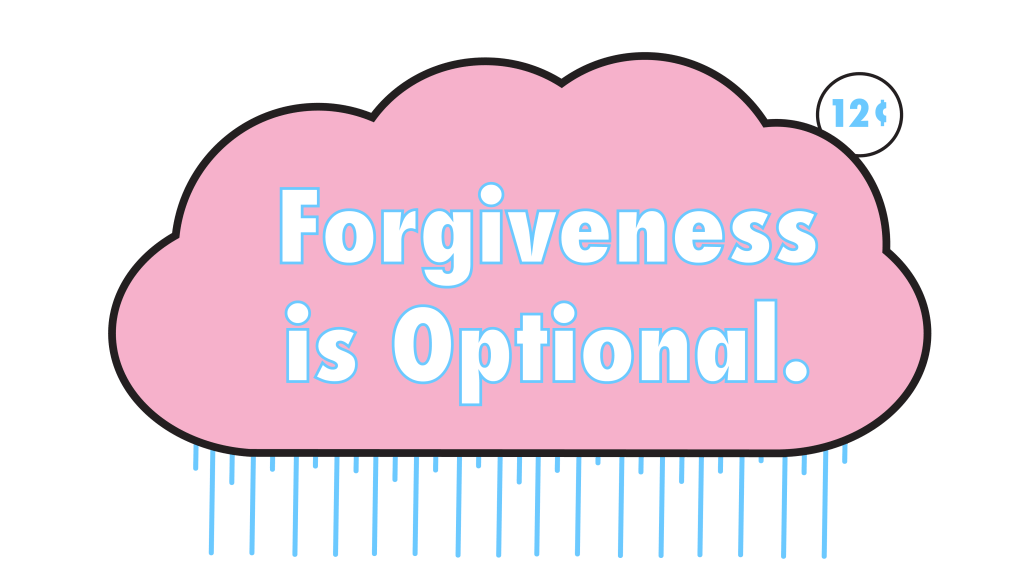
    Forgiveness Is Optional. Boundaries Are Nonnegotiable.

    Somewhere along the way, forgiveness got sold like a moral subscription you’re supposed to renew forever. Miss a payment and suddenly you’re resentful, stuck, bitter, unhealed, spiritually delinquent, whatever word makes other people more comfortable with your pain.

    My secular take from the recovery trenches goes like this:

    Forgiveness is optional.

    You can do it. You can put it off. You can decide it is not happening today. You can decide it is never happening at all.

    The reason this matters has less to do with forgiveness and more to do with the way people use the word to dodge the real conversation, which is boundaries.

    People keep lumping three different things into one pile because it benefits them.

    Forgiveness is what you carry.
    Reconciliation is whether you reconnect.
    Access is what someone gets from you now.

    Those are not the same thing.

    You can forgive someone and never speak to them again.
    You can forgive someone and still keep them at arm’s length.
    You can forgive someone and still let consequences stand.

    And you can refuse forgiveness while still making clear, reasoned choices about how much access somebody gets.

    Forgiveness happens inside you.
    Access gets earned, or it gets denied.

    That’s the part people love to blur, because once you separate those things, they lose the shortcut.

    I get the appeal of “don’t take it personally.” Fine. What people do usually comes out of their damage, their fear, their chaos, their choices. It does not mean you deserved it. It does not mean their behavior defines your worth.

    But let’s not turn that into Hallmark poison.

    Harm stays real.
    Safety stays real.
    Consequences stay real.

    Understanding where someone’s behavior came from does not require you to invite it back in.

    That’s where a lot of people get slippery. They hear forgiveness and translate it into reunion. They hear healing and translate it into open-door policy. They hear compassion and start pressuring you to hand over access you worked hard to take back.

    No.

    I’m secular. I do not treat forgiveness like a spiritual tax I owe to people who harmed me.

    If forgiveness helps you put something down, use it.
    If forgiveness gets used to push you into unsafe closeness, leave it on the table.

    For me, forgiveness only matters if it helps me think more clearly about boundaries.

    How much access do I allow?
    What behavior ends contact?
    What would have to change before trust even enters the room?
    What does distance look like here?

    That’s the inventory.

    And here’s the part that gets less tidy in real life:

    There are people I have forgiven that I will never talk to again.
    There are people I will never forgive and still allow to stay in my orbit, because my boundaries hold.

    Nothing is absolute. Things can change. They change because I decide they change.

    That’s not cold. That’s control.

    A lot of us got handed the same line in recovery: forgive them so you can heal.

    Sometimes that helps.
    Sometimes it turns into pressure dressed up as wisdom.

    For me, the cleaner question is this:

    What protects my peace and supports my recovery today?

    That’s the question. Everything else is posture, theater, and other people trying to feel better about your pain.

    What protects my peace.
    What supports my recovery.
    Today.

    I run on a simple rule: take action, do not react. Think clearly before your response.

    Forgiveness can be an action.
    Distance can be an action.
    No contact can be an action.
    Letting someone back in can be an action.

    The point is not performance. The point is reasoned choice.

    This happened. It was wrong. It affected me.
    Now it doesn’t get to run my decisions.

    That’s boundaries.
    That’s recovery.
    That’s integrity.

    Boundaries are the part people love to talk around. I don’t.

  • Who’s Your Daddy?

    Who’s Your Daddy?

    There’s a special kind of whiplash that happens when your life is already on fire, you drag yourself into a 12-step room, and people start pointing you toward God like that’s the easy part.

    I knew I needed help.
    I knew my best thinking had done plenty of damage.
    I also knew I did not believe in some guy in the sky managing my case file.

    That was the problem.

    Step Two says we came to believe that a power greater than ourselves could restore us to sanity. On paper, that sounds flexible enough. In real life, plenty of rooms still drift straight into church language, God talk, and spiritual shorthand that makes secular, agnostic, or religion-burned brains want to quietly back out the door and go smoke in the parking lot.

    I was not interested in faking belief to make a room more comfortable. I wanted a healthier way to live. I wanted something solid under my feet. I wanted a way out of the same loop of chaos, guilt, grand plans, collapse, repeat.

    Here’s Step Two in plain language:

    You cannot fix your mind with the same broken tools that helped wreck your life.

    That part, I agree with.

    My problem was the default setting. Capital-G God. Church God. Sunday-school God. The God people want me to trust always seemed to show up on demand for reassurance and disappear on schedule for suffering.

    I do not trust that God.

    I also do not trust myself enough to hand my ego a fake crown and call it enlightenment.

    So I had to build something else.

    The only past I know for sure is that I was born.
    The only future I know for sure is that I will die.
    The only reality I can actually touch is now.

    That cuts through a lot of nonsense.

    Recovery stops looking like some giant spiritual theory and starts looking like a much meaner question:

    What are you going to do today?

    The next piece came easier once I stopped trying to force old language to fit.

    I am not the center of the universe. I am one person moving inside a much bigger system of people, consequences, damage, care, time, and cause and effect. My choices ripple outward. Sometimes they help. Sometimes they leave a mess.

    So my higher power is not a sky daddy, a church doctrine, or some invisible office manager handling my paperwork.

    My higher power is an internal sense of moral order that exists for the good of the whole.

    That’s it.

    I have now.
    I am part of something larger than myself.
    My actions affect that larger whole.
    There is a way to live that causes less harm than the way I used to live.

    That is enough for me.

    It is bigger than me, but it does not let me off the hook.

    That’s where I split from a lot of recovery talk. Prayer may calm people down. Meetings may help. Meditation, walking, therapy, volunteering, all of that can help too. I’m not against any of it. But none of it does the work for you.

    For me, handing my life over to some invisible suggestion box is not spirituality. It’s avoidance with better branding.

    My higher power does not let me dump my mess into the void and stroll away feeling spiritually moisturized. It asks a much harder question:

    What are you actually going to do now?

    That’s the only part I can use.

    When my brain starts screaming about everything at once, I come back to two questions:

    What is the next sane action, right now, that does not make my life worse or send damage flying into somebody else’s day?

    Can I get through this day without turning my pain into shrapnel for the people around me?

    Sometimes the answer is small. Eat something. Shower. Answer one email. Take a walk. Draw something. Write. Send one honest text that says I’m struggling.

    Sometimes it’s bigger. Tell the truth in therapy. Set a boundary. Stop enabling somebody. Ask for help before I implode and call it independence.

    I am not reporting to a sky daddy. I am reporting to that moral order. The part of me that knows when I am full of shit, when I am doing harm, when I am lying to myself, and when I need to do better.

    I am not talking about the fake greater good people use to justify abuse, control, or cruelty. I mean the real thing. Less harm. More honesty. More care. More responsibility for my side of the street.

    The higher power I got handed as a kid asked for belief.

    This one asks for action.

    It does not rescue me from consequences.
    It does not excuse me from the work.
    It does not let me outsource my mess and call it spiritual growth.

    It reminds me of three things:

    You are going to die.
    You are not the center of the universe.
    You have today.

    Act like it matters.

    For me, that’s enough.

    If you’re a God-optional brain staring at Step Two, you do not need to swallow somebody else’s doctrine to stay alive. You do not need to fake belief. You do not need to nod along when the language does not fit.

    You can build a higher power out of time, mortality, responsibility, and moral order.

    Then you get up and do the work.

  • “Knock Knock. Who’s There? Not God.”

    “Knock Knock. Who’s There? Not God.”

    I was sitting in a meeting recently, listening to someone talk about their “God Can.” Whenever life hands them something too heavy, too messy, too painful, they toss it in the can and let God deal with it.

    I understand the appeal. It sounds clean. Reassuring. Efficient. A spiritual drop box for all the things you do not want to carry.

    I also think it can turn into bullshit fast.

    I’m not knocking anybody’s faith. I’m not interested in policing what helps someone survive. I believe in a higher power too. Mine simply does not function like a divine janitor. It does not take my mess, scrub the stains, and leave me with a fresh spiritual bounce in my step. It points. It presses. It asks harder questions. Then it leaves me holding the mop.

    That matters, because recovery does not happen through disposal. It happens through contact.

    The “God Can” idea sounds harmless until you look at what people do with it. Too often, it becomes a nicer way of avoiding the work. The same mess still sits there. The same patterns still run. The same damage still leaks into everything. All that changed is the packaging.

    That is not recovery. That is relocation.

    It’s like cleaning garbage off the beach and dumping it in a landfill, then congratulating yourself because the shoreline looks prettier. The mess did not disappear. You moved it. Recovery works the same way. If you keep shoving your problems somewhere else and calling it surrender, they still own you. They still leak. They still find their way back into your life through behavior, avoidance, resentment, dishonesty, and whatever other costume they feel like wearing that day.

    At some point, you’ve got to flush it down.

    Not hand it off.
    Not label it spiritual.
    Not pray over it until it sounds prettier than it is.

    Deal with it.

    That is where I part ways with a lot of recovery language. I have no issue with hope. I have no issue with faith. I have no issue with prayer if it steadies somebody long enough to make the next right move. What I have an issue with is the moment faith starts doing the job of accountability.

    Hope can keep you from folding.
    Prayer can calm your breathing.
    A meeting can stop you from isolating.
    None of that makes an amends for you.
    None of that changes your habits for you.
    None of that cleans up the wreckage for you.

    Somebody still has to do the work.

    That somebody is you.

    I’m secular, so I do not believe in a higher power that reaches down and lifts the weight off my shoulders because I asked nicely. My higher power does something much less comforting and much more useful. It keeps pointing me back toward moral order, responsibility, consequence, and action. It asks what helps the whole. It asks what causes less harm. It asks whether I am telling the truth, making excuses, or trying to dump my life into some cosmic lost and found.

    That’s the line for me.

    Faith may carry you through a hard moment. It may stop you from face-planting. Good. Take the help.

    But faith is not the shovel.
    Faith is not the apology.
    Faith is not the changed behavior.
    Faith is not the part where you stop lying, stop hiding, stop blaming, and stop feeding the thing that keeps dragging you under.

    That part belongs to you.

    A lot of people want recovery to feel cleaner than it is. They want peace without inventory. Relief without consequence. Grace without effort. They want to toss the ugliest parts of themselves into a God Can and walk away lighter.

    I don’t buy it.

    If something helps you face yourself more honestly, use it.
    If something helps you avoid yourself more elegantly, be careful.

    That’s the difference.

    Recovery does not need a sky daddy to fix you. It needs your willingness to face the shit you’ve been dodging, name it, sort it, and stop spreading it around. You can lean on belief for strength. Fine. But somebody still has to take out the trash.

    Again, that somebody is you.

  • Why Pink Cloud Comics?

    Why Pink Cloud Comics?

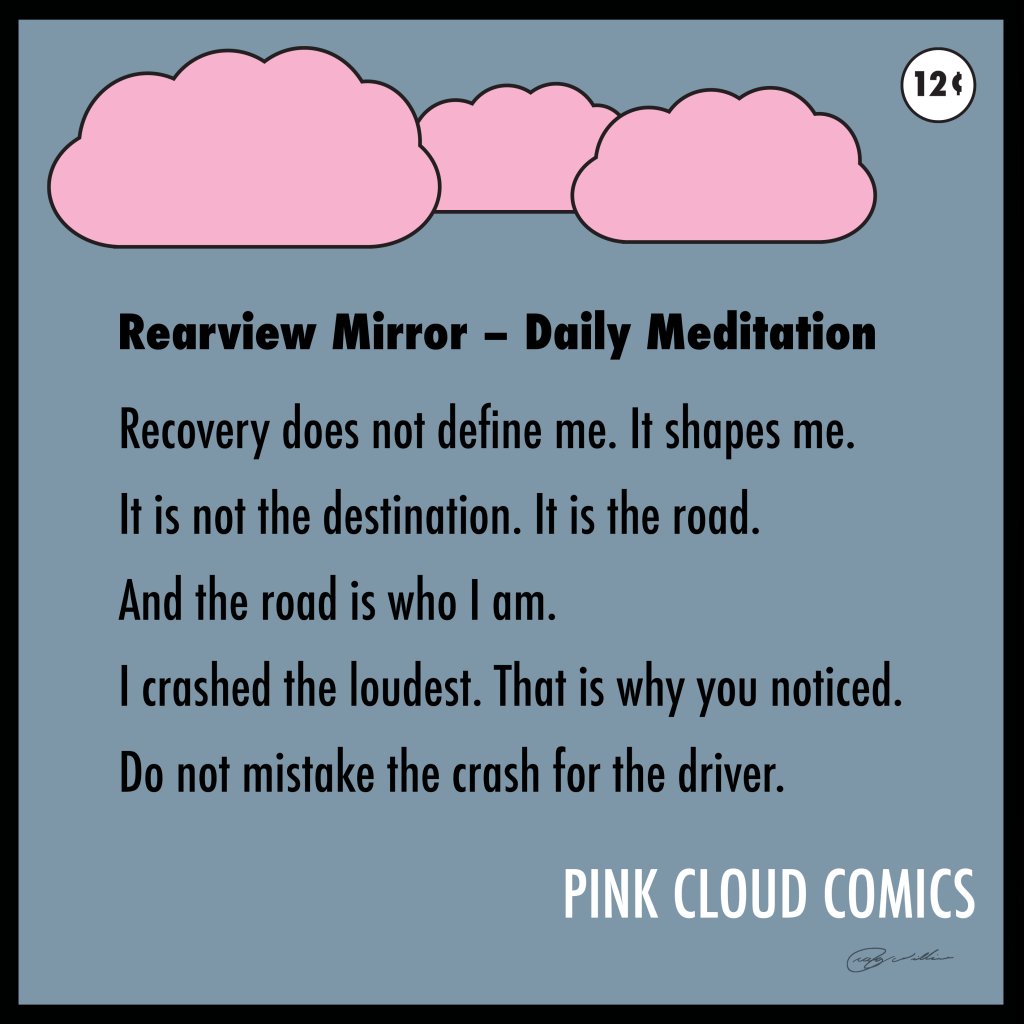
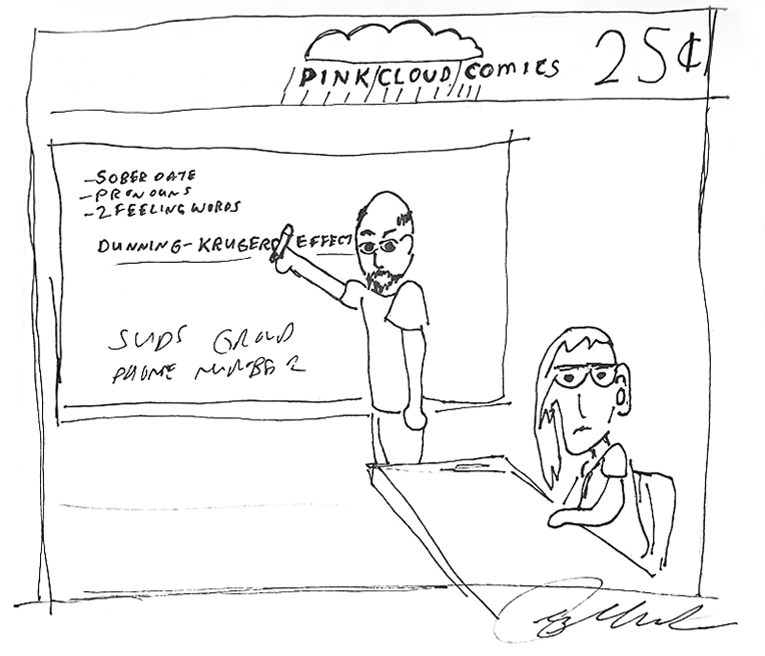
    Pink Cloud Comics started as doodles in rehab.

    That was not some grand creative breakthrough. It was one of the only things keeping me sane while I sat in rooms full of strangers trying not to crawl out of my own skin.

    I drew because talking helped some, but drawing helped more. It gave my brain somewhere to go besides panic, shame, and the usual urge to bolt. Somewhere in there, the doodles turned into Pink Cloud Comics.

    The comics came first. Then the blog.

    The comics are the fast version. They take the mess and shrink it into something I can look at without choking on it. They are not high art. They are not laugh-until-you-cry funny. They are more like half-smile, grimace, nod, keep going funny. A little bland sometimes. A little crooked. But they help. And if they help me, they might help somebody else too.

    The blog is where the rants get structure.

    That’s where I take the bigger thoughts, the recovery language that gets under my skin, the spiritual clichés, the accountability stuff, the boundaries, the God-optional brain problems, and try to say it cleanly. Not neatly. Cleanly.

    Because recovery is not neat.

    Recovery is a strange place. People picture soft voices, gratitude, insight, forgiveness, and a room full of people learning how to glow. Sometimes you get that. Other times you get somebody microwaving a burrito still wrapped in foil in detox and a room full of sedated zombies trying to evacuate during a fire alarm.

    Sparks did, in fact, fly.

    That is also recovery.

    That is part of why this exists.

    Pink Cloud Comics lives in the gap between “my life exploded” and “apparently I still have to be a person now.” It lives between shame and honesty. Between relapse scares and shit coffee. Between wanting relief and realizing nobody else can do the work for you.

    I used to think recovery would come with a built-in belief system and a clean set of instructions. It didn’t. Once I got past the stupid God stuff and let myself be what I actually am, an agnostic atheist trying to live better, life got simpler. Not easier. Simpler.

    I stopped trying to fake language that didn’t fit.

    I stopped trying to make myself believe in a sky daddy I do not trust.

    I built my own rules instead. Inclusive recovery. Less harm. More honesty. More accountability. More responsibility for my side of the street. More room for people who believe, people who doubt, and people who have been burned by religion so badly they bolt when the room starts sounding like church.

    That is the version I can live with.

    Pink Cloud Comics comes out of that version.

    It is for people in recovery, people circling recovery, people who love someone in recovery, and people who have ever had the deeply unimpressive realization:

    Okay, cool. I didn’t die. Now what?

    That question matters more to me than polished answers.

    Humor matters too. Not because recovery is light. Because sometimes humor is the only honest move left. Sometimes a joke gets through faster than a lecture. Sometimes a panel can hold something ugly without turning it into a sermon. Sometimes laughing at yourself is the first sign you are finally looking at yourself clearly.

    That is what I’m doing here.

    The comics are the quicker hit.
    The blog is the longer breath.
    Both come from the same place.

    I am not here as an expert. I am here as somebody walking this in real time, trying to stay honest, trying to do less harm, trying to keep a sense of humor, and trying not to turn into a walking recovery brochure.

    If we can tell the truth, own our mess, and still laugh once in a while, that’s recovery with teeth.

    That’s Pink Cloud Comics.